



Most outsourced software projects do not fail because of bad code. They fail because the wrong partner was chosen for the wrong reasons: usually price, availability, or a slick sales call. This guide covers what actually matters when evaluating a software development partner in 2026: the questions to ask, the models to understand, the red flags to walk away from, and how to structure the relationship so it survives first contact with reality.
The decision everyone gets wrong at least once
According to Dun & Bradstreet’s Barometer of Global Outsourcing, 20 to 25% of all outsourcing relationships fail within two years. Half fail within five. Those numbers have not improved much in the last decade, and they are not going to improve on their own.
The failure mode is almost always the same. A founder or CTO needs a development team. They collect a few proposals, compare price and timeline estimates, pick the one that sounds most confident, and sign. Six months later they are explaining to their board why the roadmap is frozen while engineers untangle authentication logic spread across 47 different files.
The irony is that most of the information needed to make a good decision was available before the contract was signed. It just was not asked for.
This article is about what to ask, how to evaluate the answers, and how to build the kind of working relationship that actually ships software.
First: understand what you are actually buying
Software development outsourcing is not one thing. The model you choose determines everything: the contract structure, the communication cadence, who owns decisions, and how the relationship scales.
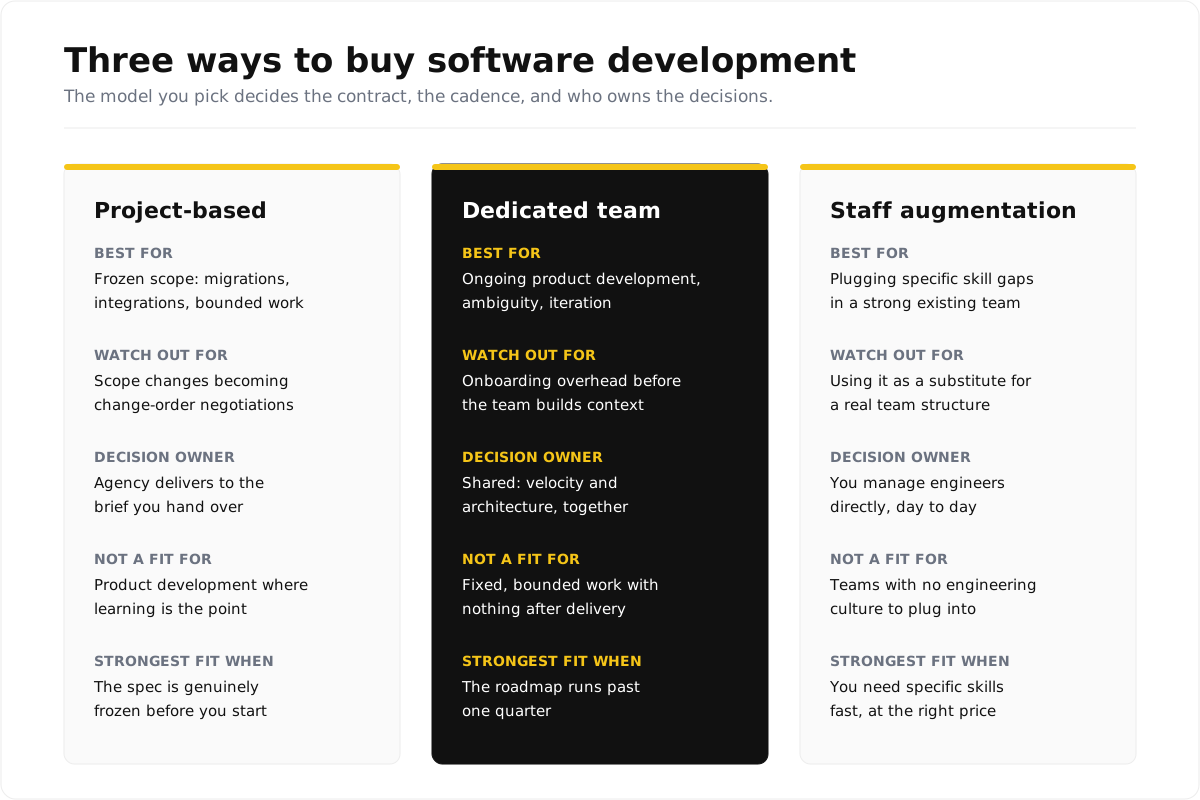
Project-based outsourcing
You define a scope, agree on a price and timeline, and the agency delivers. Clean on paper. Brutal in practice for anything that is not extremely well-specified upfront, because software requirements never survive first contact with users intact. When scope changes, and it will, a fixed-price contract turns every conversation into a negotiation over change orders.
Project-based outsourcing works when the spec is genuinely frozen: a data migration, a specific integration, a clearly bounded feature with no moving parts. It does not work for product development, where learning and iteration are the point.
Dedicated development team
A dedicated team works exclusively on your product, operates inside your tools and processes, and functions as an extension of your company rather than a vendor delivering to a brief. The team lead typically reports to you. Velocity, priorities, and architecture decisions happen collaboratively.
This model is a much better fit for ongoing product development. The team builds context over time. They know why decisions were made six months ago. They care about the codebase because they live in it every day.
Staff augmentation
You hire individual engineers, or small groups of them, through an outsourcing partner to plug specific gaps in your in-house team. You manage them directly. The outsourcing partner handles payroll, HR, and recruitment.
Staff augmentation makes sense when you have a strong engineering culture already and need specific skills you cannot hire for locally, fast enough, at a price that makes sense. It does not make sense as a substitute for building a real team structure.
The model question matters more than the partner question. Most evaluation frameworks jump straight to “which company should I hire?” before answering “what kind of engagement do I actually need?” Get the model wrong and the best partner in the world cannot save you.
What separates good partners from expensive mistakes
There is a consistent pattern in how bad outsourcing engagements start. The agency presents a polished deck, agrees to your timeline with minimal pushback, quotes a number that beats the competition, and talks confidently about their process. You sign.
None of that is evidence of capability. It is evidence of a good sales team.
Here is what you should actually be evaluating:
How they handle a vague requirement
Give any prospective partner a deliberately underspecified problem during the proposal stage. Tell them you want to “build something like Uber, but for lawn care.” Watch what happens.
A good partner slows down. They ask about your target market, your operational model, whether drivers or homeowners initiate, how pricing works, what the MVP actually is, and how you are thinking about growth. They push back on the timeline before they agree to one.
A bad partner writes a proposal within 48 hours with a fixed price and a 12-week timeline. They will figure out the details later. The details are where projects die.
Who will actually work on your project
Sales teams at software agencies are almost always more senior than the delivery teams. The partner or director who ran your sales process will not be writing your code. Ask directly: who are the specific engineers assigned to this project, what have they built before, and can you speak with them before signing?
If the answer is evasive, something like “we will assign the right team once the contract is in place,” that is a red flag. You are not buying an agency. You are buying the judgment and capability of specific people.
Their relationship with past clients
Ask for two or three client references and actually call them. Ask those clients: Did the agency communicate problems early or late? Did the final cost resemble the estimate? If you had to do it again, would you use them? How did they handle a disagreement?
An agency with nothing to hide gives you references immediately and tells you to ask whatever you want. An agency that manages the reference process, curating who you can speak to and what they have been briefed to say, is hiding something.
How they estimate
Good software estimates are ranges, not point values. They come with explicit assumptions, clearly stated risks, and an explanation of what would cause the number to move in either direction.
Bad estimates are round numbers delivered with confidence. “$80,000 and 16 weeks” is not an estimate. It is a guess presented as certainty to win the deal. The CHAOS report from the Standish Group found that 52% of IT projects exceed their original time or budget. The number one cause is estimates that were optimistic to begin with.
Their quality assurance process
Ask specifically: what is your QA process, and who owns it? The wrong answer is “the developers test their own work.” The right answer describes dedicated QA engineers, automated test coverage, CI/CD pipelines, and a defined definition of “done” that includes testing criteria.
Poor software quality costs US companies an estimated $2.42 trillion annually, according to research published by the Consortium for IT Software Quality. Most of that cost accrues after launch, in the form of bugs fixed under pressure, features rebuilt because the foundation was wrong, and technical debt that silently compounds until the codebase becomes unmaintainable.
The nearshore vs. offshore question
Geography matters more than most buyers admit. Not because of talent quality (you can find excellent engineers on every continent), but because of the practical realities of running a distributed team across different time zones, languages, and working cultures.
Offshore teams based in Asia or Eastern Europe can offer meaningful cost advantages. Hourly rates in Asia typically run $25 to $50; North American rates run $80 to $150. For a team of five engineers, that gap is real money. The trade-off is a working day overlap that may be two hours or less, which compresses your ability to unblock each other in real time.
Nearshore teams (Latin America for US companies, Eastern Europe for Western European companies) sit in compatible or adjacent time zones. The cost advantage over onshore is still significant. The daily collaboration overhead is much lower. Latin America’s tech export market has been growing at double digits for several years, with Mexico, Colombia, and Brazil producing strong development talent at competitive rates. For US startups specifically, the time zone alignment argument for nearshore is hard to dismiss.
The honest framing: the best offshore team you can find will outperform a mediocre nearshore team every time. Time zone is a factor, not a trump card. Do not use it as a shortcut to avoid properly evaluating the team.
What startups specifically need to get right
The dynamics of choosing a software development partner are different for startups than for established companies, and most evaluation advice is written for the latter.
Startups are not running stable, well-defined products. They are running hypotheses. The software needs to change fast, in response to what users actually do rather than what the spec said they would do. A partner that is optimized for execution, efficient at building what they are told, is not the same as a partner that is useful for exploration and iteration.
Startups also typically cannot absorb the cost of a failed engagement the way a larger company can. A Fortune 500 company writes off a bad outsourcing relationship as a line item. A seed-stage startup writes it off as the company.
The MVP trap
A lot of startups hire an outsourced team to build a first version, then plan to hire in-house engineers later. This works fine when the outsourced MVP is clean, documented, and built on sensible foundations. It becomes a crisis when the agency built fast and loose, the codebase has no tests, and the in-house team inherits something that costs more to fix than to replace.
The question to ask any agency building your MVP: “What would a competent engineer who was not involved in this project need to take it over?” The answer tells you whether they are building something transferable or something they intend to own indefinitely.
Technical debt after your first funding round
Technical debt accrued during the MVP phase is not inherently bad. Moving fast requires making trade-offs, and not every trade-off needs to be resolved before you find product-market fit. The problem is when the debt is invisible: the founders do not know it exists, have not quantified it, and discover it only when a key engineer quits and nobody else can understand the system.
Ask any potential partner how they track and communicate technical debt during an engagement. The answer should include specific practices: debt logging in the backlog, regular architecture reviews, a policy for when debt gets addressed versus deferred. “We write clean code” is not an answer.
What happens if you need to switch partners
Before you sign, read the IP and source code ownership clauses carefully. Most reputable agencies assign full IP ownership to the client from day one. Some do not, or bury conditions that complicate transfer. Make sure you have access to all repositories, cloud accounts, and infrastructure credentials from the start. Not on request. From the start.
An agency that makes it hard to leave is an agency that knows you will want to.
The evaluation process, step by step
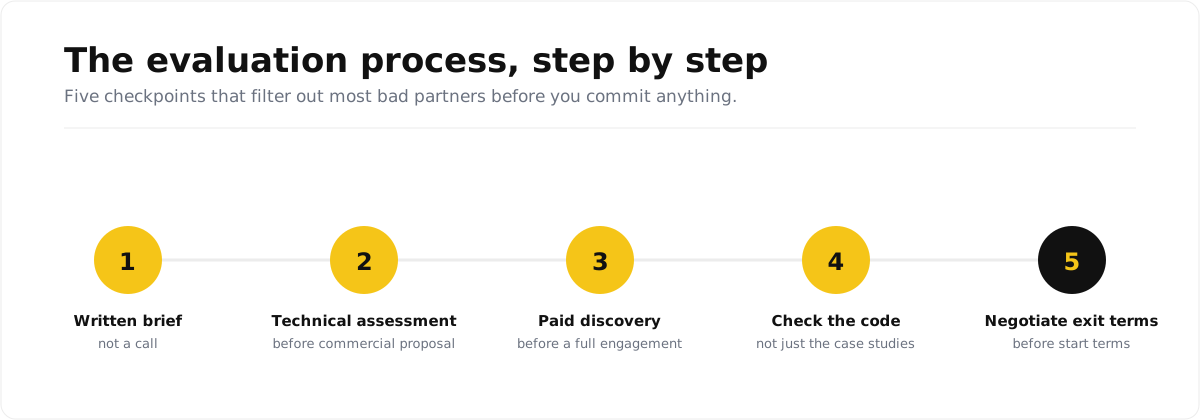
Here is a practical sequence that filters out most bad partners before you have committed anything:
Start with a written brief, not a call. Send prospective partners a document describing your project, your goals, your timeline, and your budget range. Watch how they respond. Agencies that jump straight to a sales call without reading it carefully will cut corners on delivery too.
Ask for a technical assessment before a commercial proposal. A good partner wants to understand the problem before they price it. Ask them to walk you through how they would approach your architecture, your tech stack, and your biggest technical risks. This conversation tells you more about their capability than any portfolio ever will.
Run a paid discovery phase before a full engagement. A two to four week paid discovery, where the agency produces a technical spec, architecture document, and revised estimate, costs a few thousand dollars and tells you everything about how they work. If they will not do a paid discovery, that is information too.
Check the code, not just the case studies. If the agency has open source work or can share sanitized code samples from past projects, look at it. Not to evaluate whether it is perfect, but to evaluate whether it is coherent, documented, and maintainable. An active GitHub profile with real commit history is worth more than a polished case study PDF.
Negotiate the exit terms before you agree to the start terms. Define what happens at the end of the engagement: who owns what, how handover works, what documentation is required, and what the process is for transitioning to a new team. Agencies that balk at this conversation are the ones where the exit becomes a dispute.
Red flags worth walking away from
Not every red flag kills a deal. But these ones usually should:
- They agree to your timeline without asking questions. Every project has risks that affect timeline. An agency that does not surface them in the proposal stage is either not looking or not telling you.
- They quote a fixed price for an undefined scope. This is how change orders are born. The quote is low enough to win the deal; the change orders make up the margin.
- They cannot tell you who will be working on your project. If the team is not yet assembled, you are buying a promise, not a capability.
- Their references are all glowing and none of them describe a specific hard moment. Every real project has a hard moment. References that only describe smooth sailing have been coached.
- They resist a paid discovery phase. A confident team welcomes the chance to demonstrate their thinking. A team that wants to skip straight to a long contract wants commitment before accountability.
- They cannot explain what they do not know. The best technical partners are precise about their uncertainty. “We are not sure yet and here is why” is a better answer than confident guessing.
What a good engagement looks like once it is running
Getting the partner selection right is necessary but not sufficient. The relationship still has to be managed, and most of the communication failures that derail outsourced projects happen after the contract is signed, not before.
Weekly demos, not weekly status reports. A status report tells you what the team thinks is happening. A demo of working software tells you what is actually happening. They are not the same thing, and the difference compounds over weeks.
A single accountable owner on each side. On your side, one person has final say on priorities. On the agency side, one person is accountable for delivery. When both sides have that clarity, decisions happen in hours instead of days. When neither side does, decisions happen in Slack threads that nobody reads.
Explicit escalation paths. Agree before you start: if a blocker is not resolved in 24 hours, who gets involved? If an estimate turns out to be wrong by more than 20%, how is that surfaced and discussed? The teams that handle problems best are the ones that planned for problems in advance.
Regular architecture reviews. Every three to six months, someone with senior technical judgment, either from your side or a trusted third party, should look at the codebase and ask whether it is moving in a sustainable direction. Technical debt is invisible until it is not, and by the time it is visible, it is usually expensive.
How TechQuarter approaches this
TechQuarter works with startups and growth-stage companies that need a development partner, not a vendor. The distinction matters. A vendor executes a spec. A partner helps you figure out the right spec, pushes back when the timeline is unrealistic, and is invested in the product succeeding, not just in the contract being delivered.
Our engagements typically start with a structured discovery phase before any development begins. We use that time to map the technical requirements, surface the risks, and produce an estimate we can stand behind. If the discovery reveals that the project is significantly more complex than originally understood, we say so then, not six months later when the budget is exhausted.
We work primarily with US companies from our base in Eastern Europe, which puts us in a nearshore-equivalent time zone overlap for US East Coast mornings and US West Coast afternoons. We use dedicated team structures for product work and staff augmentation where clients already have strong internal engineering teams and need specific expertise.
We are not the right partner for every project. We are a good fit if you are building a serious product, have thought carefully about what you need, and want a team that treats your business outcomes as the measure of success rather than lines of code shipped.
Frequently asked questions
How do I find a software development company?
What questions should I ask before outsourcing software development?
How do I choose the right software development outsourcing partner?
What are the disadvantages or risks of software development outsourcing?
TechQuarter is a software development company working with startups and growth-stage companies across fintech, solar, logistics, and home services. We focus on long-term product partnerships rather than project delivery, and we work best with founders who know what they want to build and need a team they can trust to build it properly. Get in touch.