


Outsourcing lets a startup ship software before hiring a full engineering team, but a failed build burns runway you cannot replace. This checklist runs the decision in stages: get your own scope clear, or start with discovery if it is not, vet a partner past their curated references, lock down IP and your exit in the contract, then settle communication, security, and post-launch support before work begins. Run the same list across every vendor on your shortlist, and if you are not technical, bring in someone who is to grade the answers.
Outsourcing is how most startups ship software before they can hire a full engineering team. It buys senior skill and speed that internal recruiting cannot match at the same stage, and it spends runway you will not get back if the build goes wrong. That combination is why the decision rewards a methodical approach more than a quick start. This software development outsourcing checklist turns a high-stakes call into a sequence of concrete checks, organized by where you are in the process: getting ready, choosing a partner, signing and kicking off, running the work, protecting your data, and planning for life after launch.
If you want the fuller picture before diving into the checklist itself, our full guide to choosing a software development partner covers the whole decision end to end.
Work through it in order, and keep it open during vendor calls so you can tick items off as you go.
A checklist does not make the decision for you. It turns a leap of faith into a set of questions a capable partner is glad to answer, and a wary one is not.
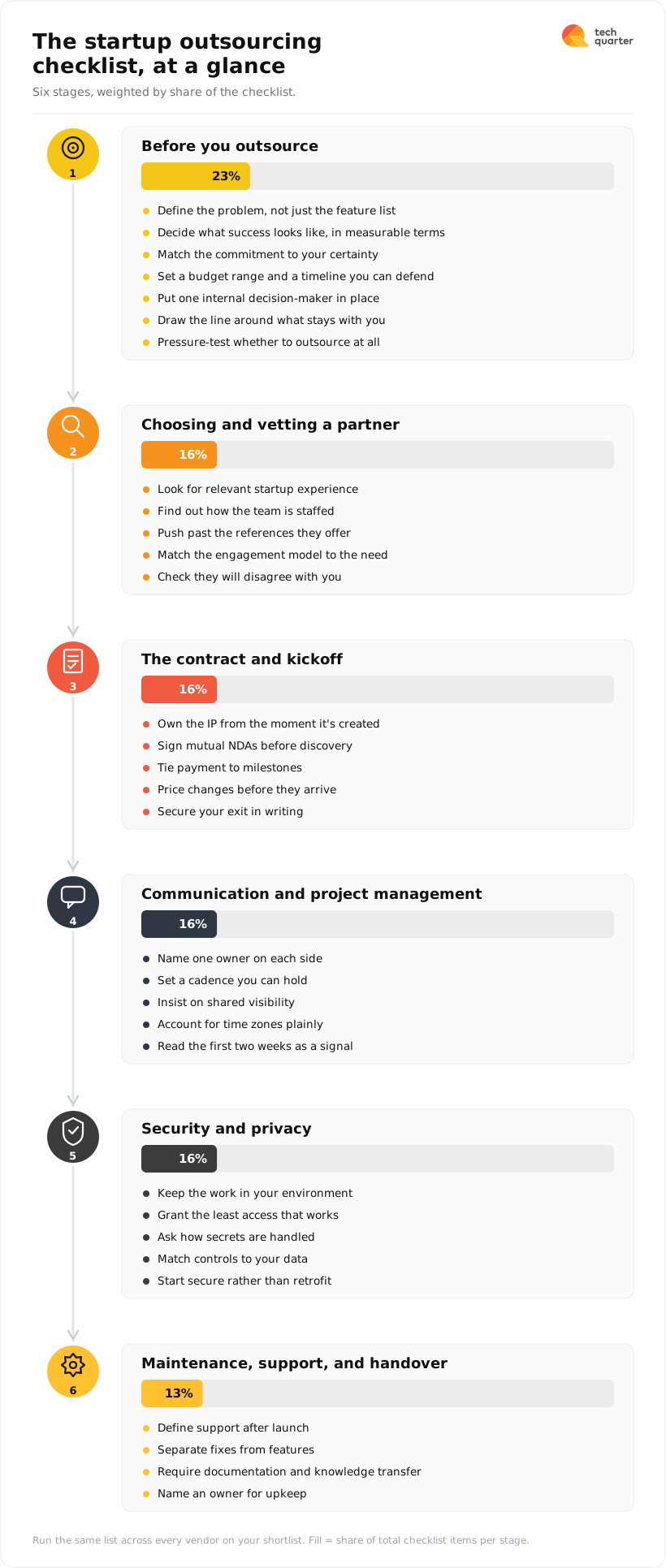
Before you outsource: get your own house in order
In practice, what derails an outsourced build is rarely the vendor’s raw skill; more often it is a brief that was never clear to begin with. Sharpen your own thinking before you brief anyone.
- Define the problem, not just the feature list. A partner can design a better solution when they understand the outcome you need rather than the screens you pictured.
- Decide what success looks like in measurable terms. Settle what the first version must do, for whom, and how you will know it worked.
- Match the commitment to your certainty. If you know the problem cold, a defined scope works. If you are still finding product-market fit, start with a small paid discovery engagement that produces a spec and an estimate, rather than committing to a full build of something you may rework once real users see it.
- Set a budget range and a timeline you can defend. You do not need a precise figure, but you need a band and an honest view of your runway against it.
- Put one internal decision-maker in place. Builds stall when nobody on your side can approve scope or sign off on work quickly.
- Draw the line around what stays with you. Product direction, customer insight, and core IP strategy are yours to keep. Be explicit about that boundary before anyone else touches the work.
- Pressure-test whether to outsource at all. If the software is your long-term differentiator, a dedicated team or an early in-house hire may serve you better than a project handoff.
Choosing and vetting a partner
Vetting a vendor thoroughly is a process in itself, and our guide to evaluating a software development company walks through the full weighted scorecard. Here, keep the selection step to the checks that count most at an early stage.
- Look for relevant startup experience. A firm geared to enterprise timelines and budgets often fits an early build badly. Ask to see work close to your stage and sector.
- Find out how the team is staffed. Get the names and seniority of your lead engineer and key roles, and ask what continuity you have if one of them moves on.
- Push past the references they offer. A vendor will only put forward happy clients, so ask for a reference they did not pre-select, or for a project that went sideways and what they did to fix it. How a firm handles a build that slipped tells you far more than a glowing quote.
- Match the engagement model to the need. A fixed-scope project, a dedicated team, and staff augmentation each suit different situations. A good partner helps you choose and lets you change models as you grow.
- Check they will disagree with you. A firm that flags a weak idea, or tells you off-the-shelf software would do the job, is worth more than one that nods along.
The contract and kickoff
The contract is where good intentions become enforceable. Read it for the handful of terms that protect a startup most.
- Own the IP from the moment it is created. Code, designs, and any models built for you should transfer to you under work-for-hire and assignment terms, with nothing depending on components the vendor has not properly licensed.
- Sign mutual NDAs before discovery. Put them in place before you share anything sensitive, not once the work is already underway.
- Tie payment to milestones. Agree a written scope and link payments to defined deliverables rather than to hours alone.
- Price changes before they arrive. Settle how change requests are estimated and approved at the outset, so the first one is not a negotiation.
- Secure your exit in writing. Agree that the codebase lives in your accounts and that you can take it, in working condition, on reasonable notice.
Communication and project management
When an outsourced project goes wrong, the cause is as often communication as code, so verify how a partner works rather than assuming it.
- Name one owner on each side. Know who holds the relationship and who can clear a blocked decision the same day.
- Set a cadence you can hold. Aim for a working demo every week or two. Seeing real software early lets you redirect while changes are cheap, where a monthly written update tends to hide drift until fixing it is expensive.
- Insist on shared visibility. Access to the backlog, the repository, and progress updates keeps you informed without waiting for a summary.
- Account for time zones plainly. Confirm the daily overlap you will actually get and how urgent issues are handled outside it.
- Read the first two weeks as a signal. How a team communicates in the opening fortnight usually holds for the rest of the engagement.
Security and privacy
Every person you grant access to is a new route into your systems, so outsourcing widens your attack surface. Verizon’s 2025 Data Breach Investigations Report found that the share of breaches involving a third party doubled in a single year, from 15% to 30%, which makes a partner’s security part of your own.
- Keep the work in your environment. When the code and infrastructure sit in your repositories and cloud accounts, sensitive data stays under your control.
- Grant the least access that works. Give each person only what the task needs, and revoke it promptly when roles change or the work ends.
- Ask how secrets are handled. Keys, tokens, and passwords should never live in code or shared documents.
- Match controls to your data. For regulated information, look for SOC 2 or ISO 27001 practices and the frameworks your sector requires, such as HIPAA for health data or PCI DSS for payments.
- Start secure rather than retrofit. Secure defaults cost far less at the outset than a clean-up after launch.
Maintenance, support, and handover
Your first release starts a longer job: keeping the software healthy. Settle how that works before a bug reaches production, not in the middle of the incident.
- Define support after launch. Agree response times for critical issues and who answers for them.
- Separate fixes from features. Be clear on what counts as a covered defect and what is billable new work.
- Require documentation and knowledge transfer. You should be able to pass the codebase to another team, or to your own future hires, without starting over.
- Name an owner for upkeep. Dependencies, security patches, and platform changes all need someone accountable once you are live.
Save your checklist for later:
How to use this checklist
Treat this software outsourcing checklist as a comparison tool, not a pass-fail test. If you are not technical yourself, do not run it alone: bring in a trusted engineer or a fractional technical leader to sit in on the vendor calls and grade the answers, since several of these checks, architecture, security, and the seniority of the team, are hard to judge without that background. Few partners will satisfy every line on day one. What matters is how clearly they answer and how much they will commit to in writing, so run the same list against each vendor on your shortlist and keep their answers. Those answers become the basis of your contract.
For a sense of what good execution looks like once you’ve picked a partner, here’s how one startup’s dedicated-team engagement played out, checklist items and all.
Frequently asked questions
What questions should I ask a software development company before outsourcing?
How will we communicate and manage the project?
How will you protect my security and privacy?
How do you handle bug fixes, maintenance, and support?
- Verizon (2025). 2025 Data Breach Investigations Report (third-party involvement in breaches doubled from 15% to 30%). verizon.com