


Most of a software project’s outcome is decided before you sign, in how well you vet the partner. Evaluate on evidence across six areas: relevant track record, technical process, security, financial stability, communication, and contract terms. Score your shortlist with a weighted scorecard instead of trusting the pitch, insist on IP ownership and a clean exit in writing, and run a small paid trial before you commit. The right partner is the one most likely to succeed at your project, not the most polished in the room.
Choosing a development partner is one of the few decisions where most of the outcome is settled before any code gets written. The work you do to evaluate a software development company, the questions you ask, the evidence you check, the contract terms you hold firm on, has more influence on whether the project succeeds than the technology stack or the day rate ever will. This is one piece of the larger decision covered in our full guide to choosing a software development partner; this guide goes deep on the vetting step specifically: what to look at, what to ask, and where to be willing to walk away.
The stakes are not abstract. Analysis from McKinsey, widely cited across 2025 reviews of IT delivery, found that only about one in 200 technology projects hits all three of its core targets: on time, on budget, and delivering the intended value. The same body of research found that projects missing those targets ran roughly 75% over budget, 46% past schedule, and delivered about 39% less value than promised.
The numbers behind the risk
The pattern buried in those figures is that scope discipline and a capable, well-run team matter far more than budget or brand. The Standish Group’s long-running CHAOS data makes the point bluntly: small, tightly scoped projects succeed around 90% of the time, while large, sprawling ones succeed less than one time in ten. Evaluation is how you find a team that keeps your project on the right side of those odds before you commit a dollar.
Why the evaluation matters more than the pitch
Every vendor looks strong in a portfolio deck. Case studies are curated, logos are impressive, and the salesperson is, by design, the most polished person you will meet during the engagement. None of that tells you whether the people who will actually build your product can design, ship, and maintain the specific system you need under real constraints.
So the goal of a software vendor evaluation is to move past the pitch and gather evidence. Past performance on work similar to yours is the most reliable predictor of future performance. A company that excels at ten-person marketing sites may not have the project management depth to deliver a regulated fintech platform, and the reverse is just as true.
Evaluate the team, not the abstract. You are not looking for the most impressive vendor on paper. You are looking for the one most likely to succeed at your project.
What to evaluate before you sign
A useful software development partner evaluation covers six areas. None is optional, but their relative weight shifts with the project. For anything touching customer data or payments, security climbs the list. For a long, evolving build, communication and process matter most.
Relevant track record, not just a portfolio
Ask for one or two case studies close to yours in scope, complexity, and industry, then ask to speak to those clients directly. Reference calls surface things no deck will: how the company handled the moment a deadline slipped, how change requests were priced, whether the people in the pitch were the people who did the work. Check how long the company has operated and whether it has a record of finishing projects rather than starting them. A firm that has shipped comparable systems repeatedly will estimate your work more accurately and hit fewer surprises.
Technical capability and engineering process
Ask who your lead engineer or architect will be, how many similar systems they have shipped, and what happens if a senior person leaves mid-project. Have them walk you through their delivery process from backlog to production: branching and code-review norms, how automated their testing is, release cadence, and how they handle scope changes. A company with a real process can draw it for you on the spot. One that improvises will struggle to make a fixed-scope commitment predictable.
Security and compliance
If your product handles customer data, payments, or anything regulated, treat security as a core business risk rather than an IT detail. The 2026 baseline that serious development firms can meet includes SOC 2 Type II certification scoped to match how they handle data, ISO 27001 for systematic information security management, and a third-party penetration test within the last twelve months. Regulated work adds requirements on top: HIPAA agreements for US healthcare data, GDPR data-processing agreements for any EU-resident data, and PCI DSS for payments.
This is not box-ticking. Verizon’s 2025 Data Breach Investigations Report found that about 30% of breaches now involve a third party, roughly double the share from a year earlier, and IBM’s 2025 figures put the average supply-chain breach at $4.91 million and 267 days to detect. A vendor’s security posture becomes part of your own.
Financial stability and continuity
A development company that runs out of cash mid-build leaves you with a half-finished system and little recourse. Before a high-value contract, ask for recent financial references, check a business credit report through a bureau such as Dun and Bradstreet or Experian, and confirm the firm carries professional liability insurance, sometimes called errors and omissions coverage, which protects you against negligence or failure to deliver. Ask what continuity arrangements exist if their primary office or a key supplier goes offline. A financially healthy partner can also afford to keep good people and invest in quality, which shows up in the work.
Communication and how they run a project
Poor requirements and communication breakdowns are among the most common reasons software projects fail, so how a company communicates is a delivery risk, not a soft skill. Find out who your point of contact will be, how often you will see working software, and how status gets reported. Short feedback loops, where you see usable output every week or two, let you correct course while corrections are still cheap. A partner who only resurfaces at milestones is asking you to trust a black box.
Contract terms: ownership, escrow, and your exit
Read the contract for four things in particular. First, intellectual property: confirm in writing that you own the code, designs, and any models created for you, and that the work does not depend on components the vendor has not properly licensed. Second, a source-code escrow or regular handover arrangement, so you can recover your software if the relationship ends badly. Third, service levels and liability terms that are specific rather than decorative. Fourth, your exit: how you get your data and code out, in usable formats, and on what notice. A vendor confident in the relationship will sign clear terms without heavy redlining.
What a credible estimate looks like
A trustworthy estimate is itemized, not a single round number. A capable firm breaks the work into features and phases, ties each piece to its assumptions and acceptance criteria, and shows the reasoning behind the figure. How accurate that estimate can be depends entirely on how clearly the scope is defined, which is why a real number should follow a discovery phase rather than come before it. Be wary of any firm that quotes a precise total before it understands your requirements. Treat a bid that lands far below the rest of the field with the same caution: it usually means the vendor has misread the scope or expects to recover margin later through change orders. What actually drives the price, the team mix, integrations, regulatory load, and design complexity, is a larger conversation that sits outside this evaluation, but the estimate you are handed should be specific enough to defend.
Fixed price or time and materials?
The contract model shapes both the price and the risk you carry. The right choice depends on how well you can define the scope today and how much you expect it to change.
| Fixed price | Time and materials | |
|---|---|---|
| Best for | Well-defined, stable scope | Evolving or uncertain scope |
| Cost certainty | High; price set upfront | Variable; cap with a not-to-exceed clause |
| Risk premium | Vendor adds a 15–30% buffer | None; you pay for actual work |
| Flexibility | Low; changes go through change orders | High; reprioritize as you learn |
| Methodology fit | Waterfall, predictable builds | Agile, iterative builds |
A fixed price buys certainty, but you pay a premium of 15% to 30% for the risk the vendor absorbs, and every change becomes a renegotiation. Time and materials feels riskier yet usually costs less when requirements are still moving, especially when a not-to-exceed cap protects the downside. Either way, the estimate should follow a discovery phase, not precede it.
How to run the evaluation in practice
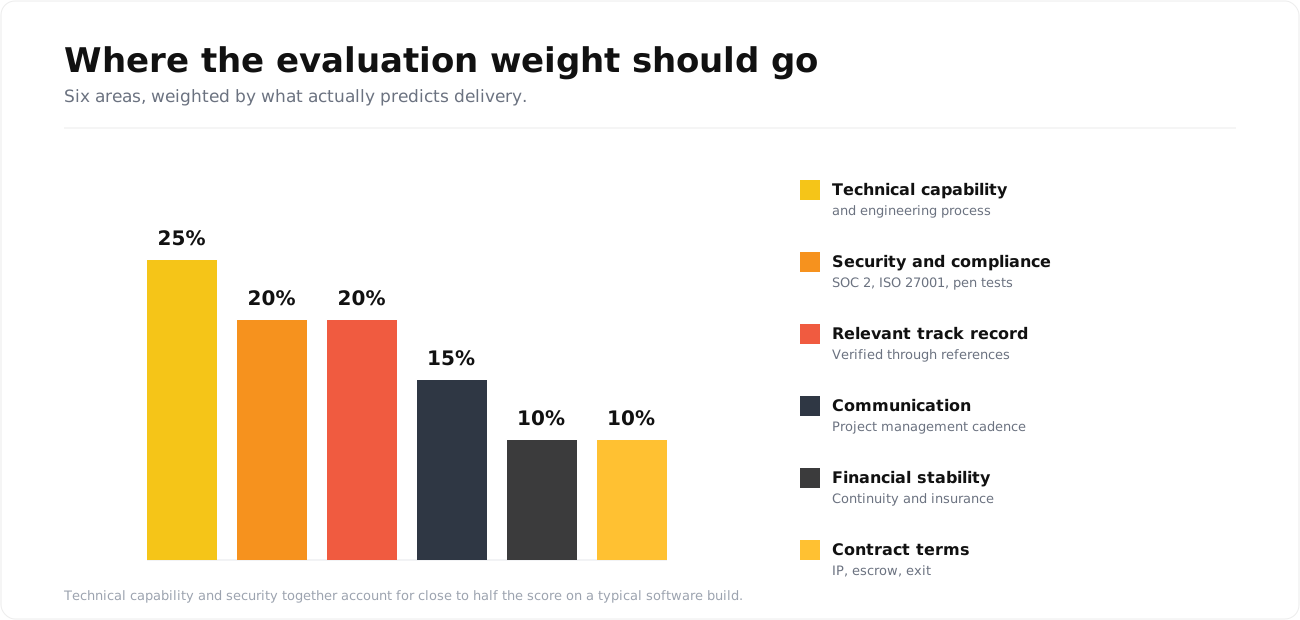
The most defensible approach is a simple weighted scorecard rather than a gut feeling. List the six areas, weight them for your project, and score each shortlisted vendor on evidence rather than impression. The weighting below adapts the scorecard model used in 2025 vendor-selection frameworks; adjust it to your own priorities.
| Evaluation area | Suggested weight |
|---|---|
| Technical capability and process | 25% |
| Security and compliance | 20% |
| Relevant track record | 20% |
| Communication and project management | 15% |
| Financial stability and continuity | 10% |
| Contract terms (IP, escrow, exit) | 10% |
Two dimensions, technical capability and security, usually account for close to half the score on a software build. Where you can, run a small paid trial, a discovery sprint or a contained first module, before committing to the full engagement. A short, real piece of work tells you more about a team than any number of sales calls.
A brief, honest note on fit: not every project needs an external partner, and a good firm will tell you when an off-the-shelf tool would serve you better than custom software. That candor is itself a signal worth weighing.
Frequently asked questions
How do I evaluate and choose a software development partner?
What questions should I ask before hiring a software development company?
How do you estimate project timelines and cost?
How do you handle quality assurance and testing?
How we’d answer our own questions
We wrote this guide as the standard we’d want to be measured against, so it seems only fair to answer it ourselves.
On security, TechQuarter holds ISO/IEC 27001 certification, so our information-security controls are independently audited rather than asserted, and we build inside your repositories, your cloud accounts, and your tools, which keeps your data in environments you control. Where your industry calls for it, we apply HIPAA practices for healthcare data, PCI DSS for payments, and SOC 2 controls.
On ownership, your IP is yours from the moment it is created, secured by work-for-hire and assignment clauses in the master services agreement, with mutual NDAs signed before any discovery begins. Because the work lives in your environment from day one, you keep a clean path to your code and data if the engagement ever ends.
On track record, we would rather you check than take our word for it. Most of our case studies name the client, the problem, and the measured result. The Clutch reviews come from the people we built that work with. And on fit, we hold to the same candor this guide asks for: we offer staff augmentation, a dedicated team, project-based delivery, and fractional technical leadership, we help you pick the model that suits your stage, and if an off-the-shelf tool would serve you better than custom software, we will say so.
If you’re earlier in this process and still scoping the build itself, our startup-focused services and our outsourcing checklist for startups are shorter, more tactical starting points than this guide.
If you are running a shortlist through these questions, we would be glad to be on it and measured by the same answers.
- Runn (2025). IT Project Management Statistics (reporting McKinsey and Standish Group CHAOS findings). runn.io
- Verizon (2025). Data Breach Investigations Report (third-party breach share), as reported in Peony, Vendor Due Diligence Checklist. peony.ink
- IBM (2025). Cost of a Data Breach Report (supply-chain breach cost and detection time), as reported in Peony. peony.ink
- Vervali (2026). How to Choose a Software Development Company: Evaluation Framework, Due Diligence Checklist, and Vendor Scoring Guide (SOC 2 / ISO 27001 baseline, source-code escrow, and scorecard weighting). vervali.com
- Baytech Consulting (2025). Time & Materials vs. Fixed Price (fixed-price risk buffer). baytechconsulting.com
- Genie AI (2025). Due Diligence Checklist: Vetting Custom Software Development Companies Before Signing (professional liability insurance, references). genieai.co
- DeviQA (2026). 20 Software Quality Assurance Best Practices (CI testing, automation benchmark). deviqa.com
- Netguru (2026). Best Practices in Software QA (testing scope, accessibility, AI in QA). netguru.com